The Fat Man
A Character Worth Meeting
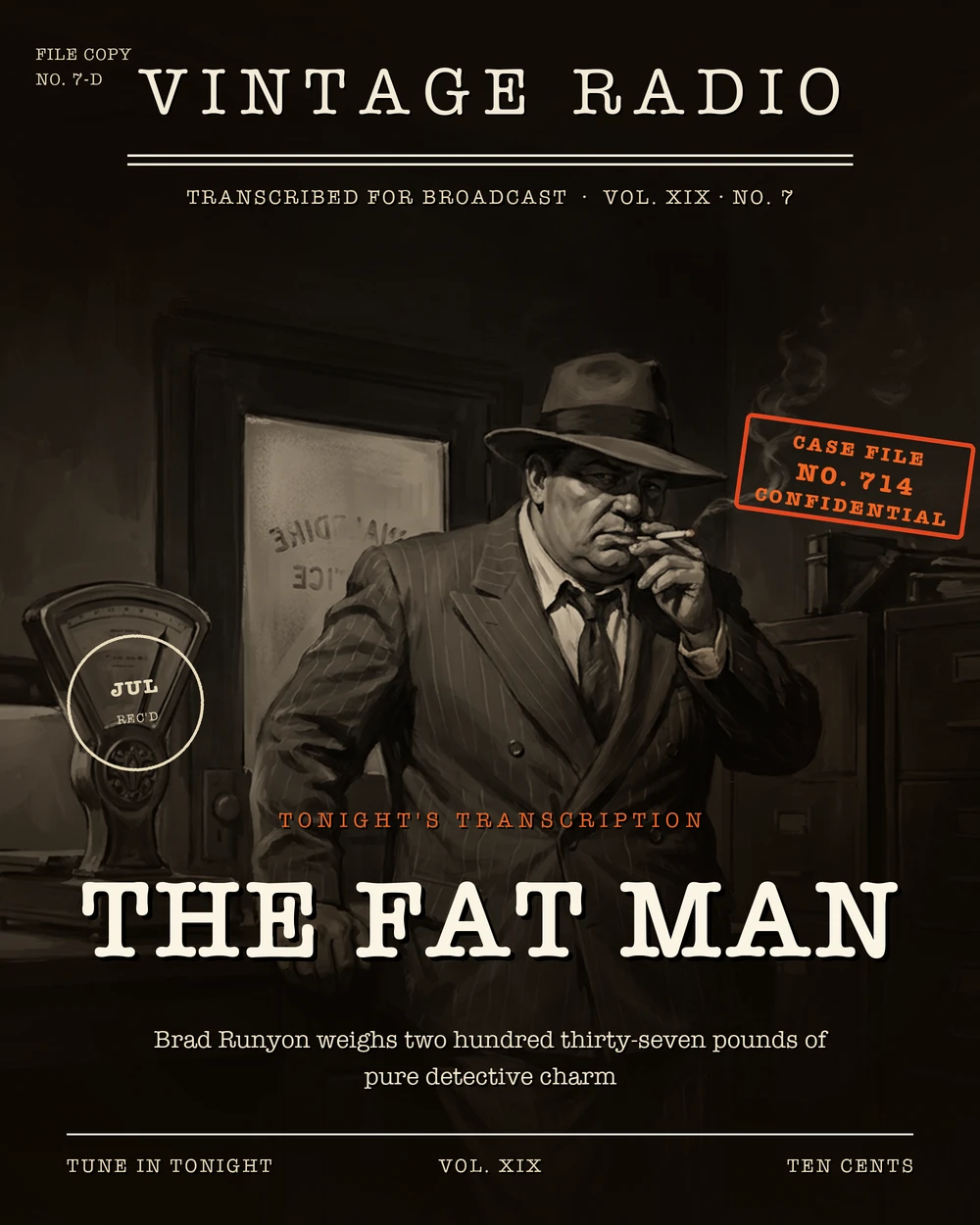
The opening of The Fat Man was one of the more carefully constructed rituals in 1940s radio. A harp trill — sweet and a little incongruous — gave the harp player a twenty-second workout before blending into the Pepto Bismol teaser. Then a woman's voice narrated as detective Brad Runyon stepped onto a drugstore scale. A penny tumbled into the slot. The scale announced his weight: two hundred thirty-seven pounds. A fortune card clattered out. The fortune read "danger." And then, in a voice that stretched certain syllables to their absolute limit, Runyon introduced himself: "The Fat Mannnnnn..." The show's theme was eight notes written specifically for the series and played on a bass horn, with an eleven-piece orchestra performing live during each broadcast. That was the contract with the audience, made fresh every week from January 21, 1946 to September 26, 1951.
The show ran on ABC for the duration, thirty minutes per episode, broadcast from the studios of WJZ in New York. It premiered as part of a block of four new programs the fledgling network launched simultaneously — alongside I Deal in Crime, Forever Tops, and Jimmy Gleason's Diner. Early on it aired Mondays at 8:30, then moved to Fridays at 8 for most of the 1947–1951 stretch, and finally shifted to Wednesdays at 8:30 near the end. The show began as a sustaining program before the Norwich Pharmaceutical Company, makers of Pepto Bismol, came on as sponsor on February 14, 1947 under an advertising package worked out the previous fall. American Chicle took over briefly in 1951. By 1948 it had become one of the top ten shows on Friday nights, drawing more than six million listeners a week, and Life magazine called it "suave, witty, hardboiled," declaring that it "provides better than average radio entertainment."
The Hammett Connection — Such As It Was
The show leaned heavily on Dashiell Hammett's name, and Hammett had almost nothing to do with it. Producer Ed Rosenberg built the show around Gutman, the bulky villain from Hammett's The Maltese Falcon — specifically the chapter titled "The Fat Man," which is chapter eleven of that novel. The resemblance between Gutman and radio's Brad Runyon began and ended with the title and the general silhouette of a large man. Unlike The Adventures of the Thin Man and The Adventures of Sam Spade, both adapted from Hammett novels, The Fat Man was created for radio, with Hammett credited only with writing a few early scripts to set the series in motion. The show was nonetheless advertised as "Dashiell Hammett's most exciting character."
Gutman in Hammett's novel was sinister and brooding. Runyon on the radio was described as hard-boiled but soft-hearted — a charmer, a witty ladykiller, a bachelor who drew women toward him even as he claimed, mournfully at the close of the first episode, that "nobody loves a fat man." The two characters occupied different moral universes entirely. Runyon bent certain words the way a jazz musician bends notes, drawing out "San Quen-n-tinn" and "murrr-derrr" with a theatrical slowness. He was not the cold-blooded schemer of the source material; he was something warmer and more self-aware. One OTR writer placed him in a tradition of large, intellectual detectives, suggesting he combined Nero Wolfe's brains and size with Sam Spade's fists. The stories themselves were typical of the detective radio of the period — action and adventure up front, with logic playing a secondary role. In the earliest episodes Runyon wasn't even named; the name "Brad Runyon" was revealed only gradually over the early run.
The Hammett association eventually became a liability. When the anti-Communist pamphlet Red Channels was published on June 22, 1950, it listed Hammett among 151 entertainment industry figures suspected of Communist sympathies. Norwich Pharmaceutical withdrew its sponsorship, and the show was cancelled along with the other Hammett-associated radio properties. Hammett himself was arrested in 1951 for refusing to name contributors to a Civil Rights Congress bail bond fund, convicted of contempt of court, and served six months in prison.
J. Scott Smart
The man behind Runyon was J. Scott Smart — born John Kenley Tener Smart in Philadelphia on November 27, 1902, his family later moving to Buffalo, where he graduated from Lafayette High School in 1922 before a stint at the Miami Military Institute. He weighed 270 pounds in real life — thirty-three more than the character — and before show business he ran through some thirty jobs in three years, selling shoe polish, heaving coal on a boat, serving as a fire chief in a factory, drawing newspaper cartoons, and designing ads for an agency. His father gave him a set of drums as he was getting out of high school, which Smart later credited as the turning point. He started with a Buffalo stock company in 1925 and broke into radio as a singing waiter on NBC's Whispering Tables. By the 1930s he was in such demand as a utility player on The March of Time and The Fred Allen Show that early radio circles called him "the Lon Chaney of Radio."
Radio Life described him as "a recluse, an extremely shy and even lonely man" — a portrait that sat oddly next to the photographs of him jitterbugging with Hedda Hopper and Julie London, or the record of him winning a Charleston dance contest. He was also an artist, a musician, and a dancer. On Broadway he played Basile Giovanni in A Bell for Adano (1944) and Taggert in Separate Rooms (1940), which ran 613 performances; he later appeared in Waiting for Godot. During the week he lived in a fisherman's shack on the Maine coast, painting seascapes. On the weekend he would fly to New York to record the show.
Radio historian Jim Harmon, in The Great Radio Heroes, praised Smart's "great booming voice and sly intonations" and wrote that "the appeal was more in the immense man with an immense appetite for life than in the tough-guy scripts written after Hammett left." Smart brought Runyon to the screen in 1951, the same year the radio series ended, in a Universal-International picture directed by William Castle that featured Rock Hudson — three years before his breakthrough in Magnificent Obsession — along with Julie London and Ringling Brothers clown Emmett Kelly as the villain. Castle later called it "a potboiler of little merit, except that I was able to cast Rock Hudson … and to use Emmett Kelly." Universal-International deliberately removed Hammett's name from the billing. A period critic remarked that Smart "was better behind the microphone than in front of the camera." After a last appearance on Robert Montgomery Presents, Smart retired from performing. He died in Springfield, Illinois on January 15, 1960.
The Cast Around Him
Ed Begley played Sergeant O'Hara, Runyon's police contact. Mary Patton played Lila North, Runyon's secretary. Amzie Strickland played Cathy Evans, identified early in the series as a friend whose presence was said to "curb wolfish women" in Runyon's orbit — a polite acknowledgment that without her, Runyon's bachelor tendencies might have overwhelmed the plots entirely. Nell Harrison played Runyon's mother during the early episodes. Other voices across the run included Betty Garde, Linda Watkins, Paul Stewart, Alice Frost, Vicki Vola, Robert Dryden, Jimmy McCallion, Sarah Burton, Dan Ocko, and Rolly Bester — the wife of science fiction writer Alfred Bester.
Charles Irving was the announcer for most of the series, with Don Lowe and Gene Kirby filling in at various points. Bernard Green composed the music and served as music director; when Green wasn't available, Joseph Stopak or Mark Winston stepped in. Ed Blainey handled sound effects. Directors included Charles Powers, Robert Sloane, and Clark Andrews. The original writing team was Richard Ellington and Lawrence Klee; later Robert Sloane, Dan Shuffman, Harold Swanton, and Frank Kane took over the scripts.
What Stayed With You
What the show built, episode by episode, was a persona more than a mystery franchise. The plotting was functional rather than ingenious — cases solved through movement and confrontation rather than careful deduction. What listeners came back for was Runyon himself: that stretched drawl, the self-deprecating humor, the peculiar combination of physical bulk and social ease. A man who weighed two hundred thirty-seven pounds by the scale's own reckoning, whose fortune card said "danger" every week, and who still somehow charmed his way through. The harp at the top of the show was part of that contradiction — not the sound you'd expect from a hard-edged detective story, but exactly right for this one.
Of the original American episodes, only about ten or eleven are known to survive — a scarcity attributed both to the Hammett connection and to ABC's then-limited resources for transcription and preservation. The surviving titles include "The Black Angel" (July 8, 1946), "The Crooked Horse" (September 9, 1946), "Murder Wins the Draw" (April 1, 1949), "Order for Murder" (May 23, 1951), "19th Pearl," "An Unfamiliar Face," and "Nightmare Murder." An Australian version of the show ran 52 episodes on the Australian Broadcasting Corporation between September 1954 and 1955, with the New Zealand–born stage and radio star Lloyd Berrell — winner of the 1953 Macquarie Award for best radio actor — taking the title role and American actor Harp McGuire playing Lieutenant MacKenzie. About 36 of those Australian episodes remain in circulation, a longer surviving run than the American original itself. As one OTR writer noted, Smart played the Fat Man longer than The Adventures of Sam Spade were on the air, and longer than Bob Bailey played Yours Truly, Johnny Dollar — a sustained tenure that today's sparse record almost entirely conceals.